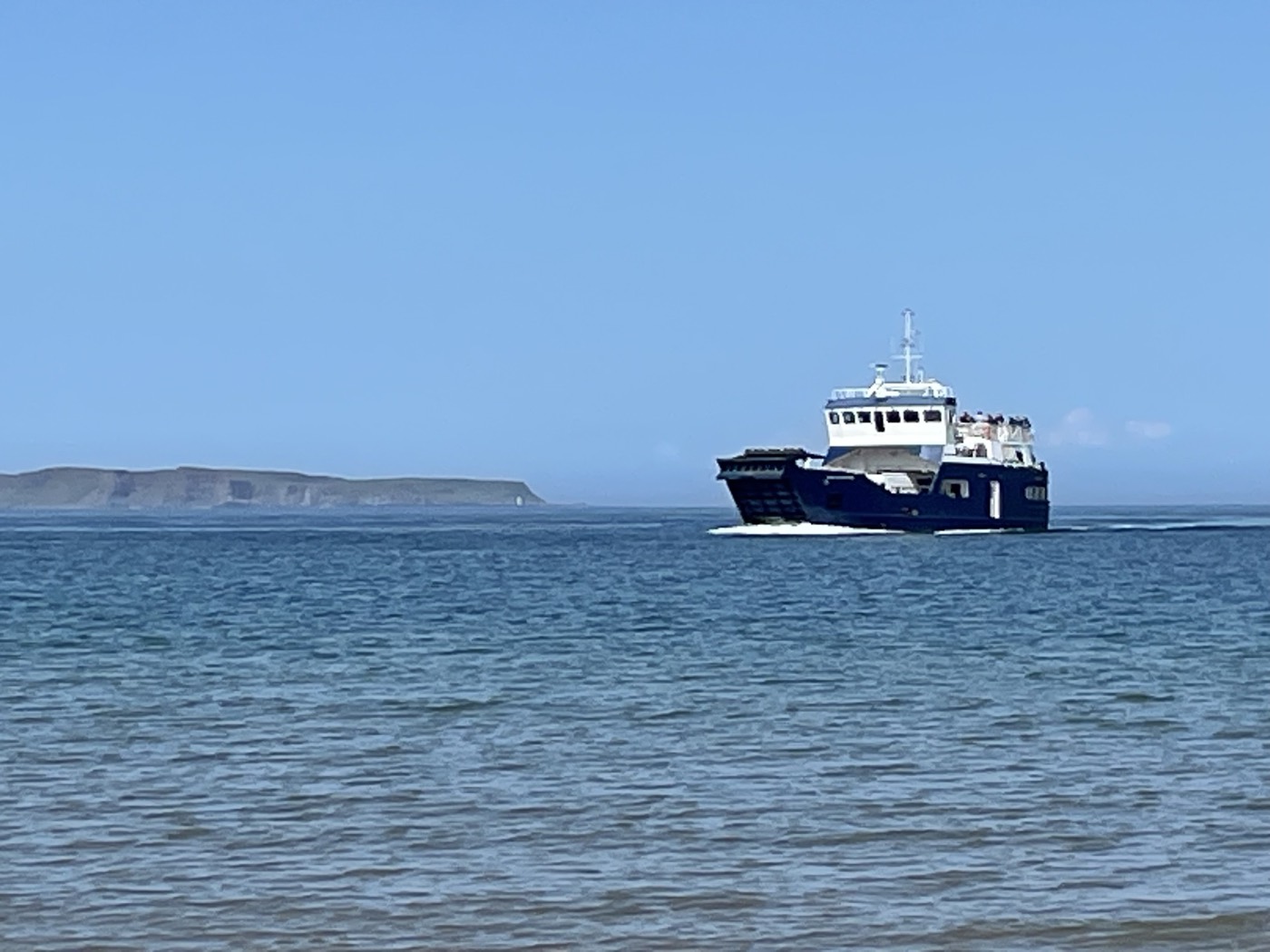
Rathlin is a small, L-shaped island about five miles (8km) off the Antrim coast, reached by passenger ferry from Ballycastle — around 25 minutes on the fast boat, or about 40 minutes on the Spirit of Rathlin, the larger passenger and vehicle ferry. Around 150 people live on the island, many from families who have been there for generations.
The ferry
Booking ahead is essential on both services to guarantee a space, especially in summer. The Spirit of Rathlin is wheelchair accessible, with a ramp and space for two wheelchairs, and can also carry bicycles and larger luggage — book bikes on ahead too, as space is limited and there’s a small fee. Dogs are welcome on board on a lead. Cars can only cross with the Spirit of Rathlin, and only if you’re staying at least six nights or hold a Blue Badge — book well in advance.
Because vehicles are restricted, the island’s roads stay quiet — good news for walking, and the main way most day-trippers get around. A seasonal Puffin Bus meets incoming ferries and runs between the harbour and the RSPB reserve at the West Lighthouse; it’s cash-only, so bring cash for that and in general — card acceptance on the island is patchy. There’s a small shop and a couple of pubs at Church Bay near the harbour, but nothing beyond it, so plan accordingly for a full day out.
Birds — RSPB Seabird Centre
The RSPB reserve runs along a stretch of basalt cliff on the island’s north coast. The viewpoint at the West Lighthouse — leased from the Commissioners of Irish Lights — gives some of the best seabird views in Northern Ireland: guillemots and kittiwakes nest by the thousand along the cliffs, while the offshore sea stacks shelter razorbills, fulmars, and puffins. Puffins are only around for a short window, roughly April to July, before heading back out to sea — time a visit for early summer if seeing them is the priority.
Peregrine falcons, kestrels, buzzards, and ravens are regular sights too, and skylarks can often be heard along the road. In the freshwater marshes, look for breeding lapwing, snipe, and reed bunting; Church Bay hosts eider, ringed plover, and oystercatcher, while black guillemot breed at the base of the cliffs.
Other wildlife
Irish hares and rabbits are easy to spot. Head to Mill Bay or the old smuggler’s house at Rue Point and you’ve a good chance of seeing both grey and common seals close up.
History
People are thought to have first reached Rathlin around 6000–5000 BC, en route to Whitepark Bay in the Middle Stone Age. By around 2500 BC the island had built a genuine export trade in axes made from porcellanite — a fine blue stone found at Brockley, one of only three such sources in Ireland — which reached as far as Crete and Tyre before copper axes made the trade obsolete around 1800 BC.
The island’s later history is a long list of changing hands — Somerled’s Argyll chieftains, Norse raiders (Rathlin was the site of the first recorded Viking raid on Ireland, in 795), the Anglo-Norman De Courcys and De Lacys, the Byssets, and eventually the MacDonnells, who held it (with interruptions) for centuries. According to island tradition, Robert the Bruce sheltered in what’s now known as Bruce’s Cave, below the East Lighthouse, after his defeat at Perth in 1306 — and it’s here that the story of Bruce watching a spider try, fail, and eventually succeed in reaching the cave roof is traditionally set, said to have inspired him to return to Scotland and win at Bannockburn.
Conflict and conquest
Rathlin’s position made it a target twice over in the 16th century. In 1557, Sir Henry Sidney raided the island during a campaign against the MacDonnells, destroying its stores of corn and cattle to cut off supplies to Scottish reinforcements — by his own account, wiping out “all mankind, corn and cattle” he found there. Worse came in 1575: with Sorley Boy MacDonnell’s own children and clanspeople sheltering on the island for safety, English forces under Francis Drake and John Norris landed and killed more than 600 of them, while Sorley Boy watched helplessly from Dunaneeny Castle on the mainland. His revenge came fast: he stormed Carrickfergus Castle, killed over a hundred there, and used the plundered cattle and corn to rebuild his power across the Glens and the Route.
Singer Mary Black’s father, a fiddle player, was from Rathlin — the island’s musical tradition runs in her family, even though Mary herself was born and raised in Dublin.