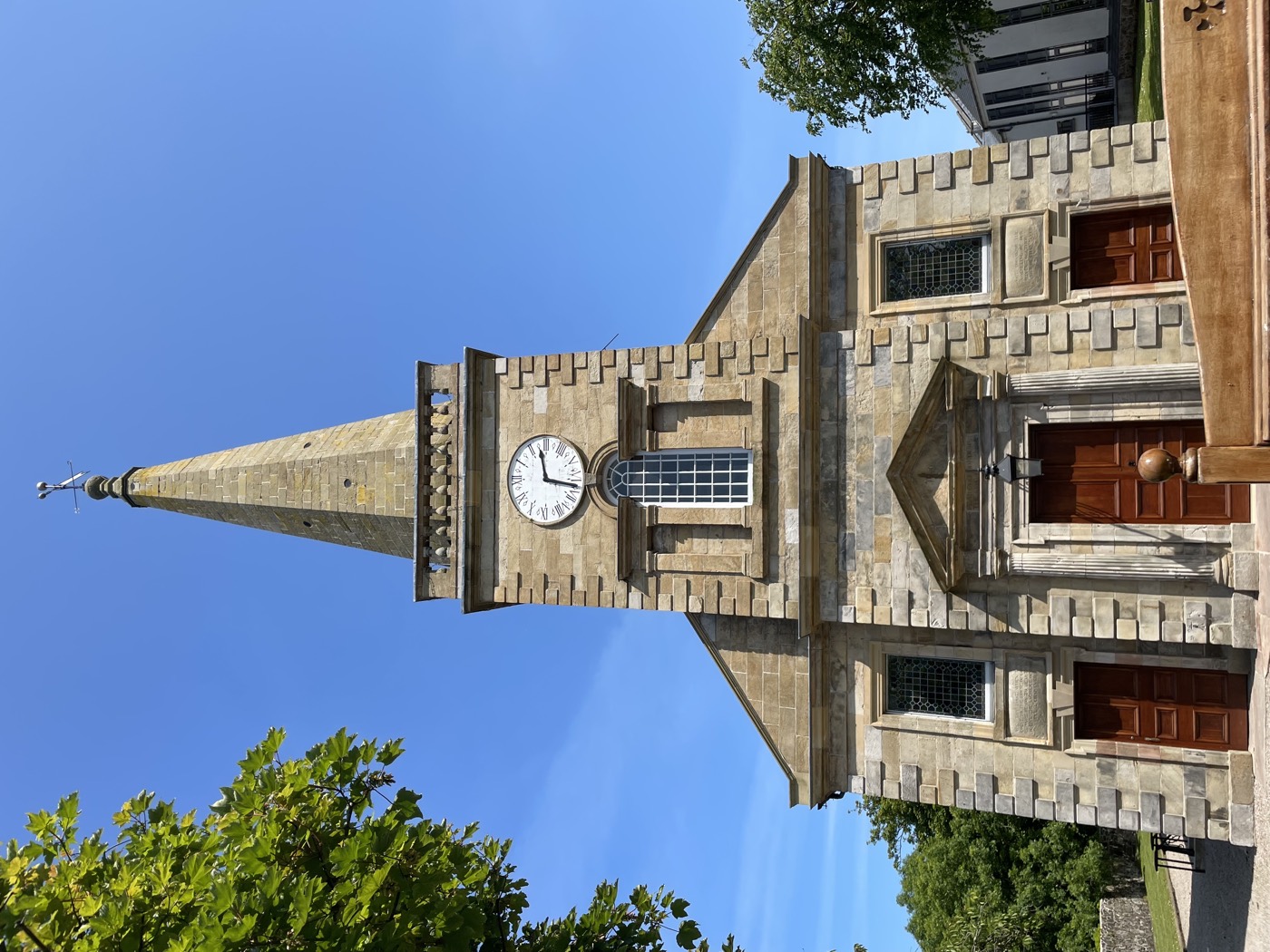
Holy Trinity — known locally as “the Town Church” — stands on the Diamond, built by Hugh Boyd at his own personal expense between 1752 and 1756, at a cost of £2,769-4-7½d. The date is carved on the pediment over the west door, above the inscription “Fear God Honour the King. I Peter ii.17. 1756.” The west front, with its balanced Georgian classical design, is thought to have been designed by Christopher Myers, the same engineer who later advised on repairs to Boyd’s harbour.
What to look for
The octagonal spire sits on a square tower that projects slightly off-square to the north-west. The west face carries the church clock; the south face has a sundial that still shows genuine Ballycastle time — 20 minutes later than Greenwich Mean Time. In 1760, a peal of five bells was cast for the church by Lester and Pack of Whitechapel, London; only the original tenor bell survives today, alongside a later bell cast by Sheridan’s of Dublin in 1853, marked with an Irish harp and the words “Erin Go Bragh.”
The apse and its large stained-glass windows are a later, Victorian addition, dated 1868; most of the coloured “cathedral glass” throughout the rest of the church was installed during Canon Barnes’s time as chaplain, 1874–1921.
Hugh Boyd’s grave
Boyd died on 15 June 1765, aged 75. His funeral, on 23 June, was attended by Lord Antrim and the gentlemen of the four lower baronies of the county; the Bishop of the diocese consecrated the chapel and his remains were laid in a vault beneath the church, where members of the Boyd and Cuppage families are also buried — commemorated on white marble and brass memorials in the chancel.
Historical detail from “Col. Hugh Boyd’s Ballycastle” (Causeway Museum Service, 2007) by Daniel J. McGill of the Ballycastle Historical Research Group.