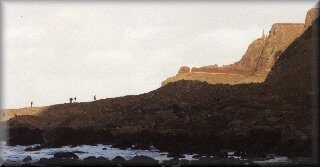
The Giant’s Causeway lies about 15 miles from Ballycastle and was declared Ireland’s first UNESCO World Heritage Site in 1986. It’s made up of around 40,000 interlocking polygonal basalt columns, mostly hexagonal, formed roughly 55–60 million years ago when lava from ancient volcanic activity cooled and cracked into columns as it settled on the shore. It draws well over a million visitors a year, and is home to more than 200 plant species and birds including chough and peregrine falcon.
The legend
The Causeway takes its name from a story about a quarrel between two giants, Finn McCool and the Scottish giant Benandonner. Benandonner is said to have built a causeway across the sea to fight Finn — who, warned of the giant’s size, disguised himself as a baby in a pram. When Benandonner saw the “baby,” he assumed Finn himself must be enormous, and fled back to Scotland, tearing up the causeway behind him. Look for the shapes locals call the Giant’s Boot, Camel, and Organ in the rock formations along the way.
Port na Spaniagh
A coastal path with spectacular views runs along the cliffs above the Causeway. Along it is Port na Spaniagh, where the Spanish Armada galleass Girona was wrecked in October 1588, carrying Don Alonso Martínez de Leiva and some 1,300 men — only nine survived. The wreck’s treasure lay undiscovered for nearly four centuries until it was found in 1967; ducats, muskets, jewelled chains, and gold cameos from the Girona are now on display in the Ulster Museum in Belfast.
Getting there
The Giant’s Causeway and Bushmills Railway, a narrow-gauge heritage line running steam and diesel trains, covers the two miles between Bushmills and the Causeway — a scenic way to arrive that’s an attraction in its own right.