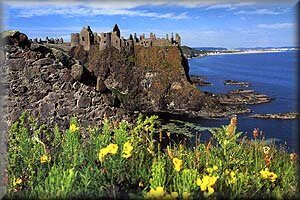
Dunluce Castle sits on a rock cut off from the mainland by sheer drops on both sides — a site that drew early Christians and Vikings before any castle stood here. The name likely derives from dún lios, roughly “fortified residence.”
Richard de Burgh, Earl of Ulster, first built a castle here in the 1200s. Its earliest surviving features are two large drum towers on the eastern side, remnants of a stronghold raised by the McQuillans after they became lords of the district in the late 14th century.
The castle changed hands more than once by force. In 1584, Sorley Boy MacDonnell (1505–1590) captured it after one of his men, working inside the castle, hauled his comrades up the cliff face in a basket. Sorley Boy came into a windfall of Spanish Armada treasure in 1588, after the wrecked galleass Girona washed ashore nearby — some of it, now in Belfast’s Ulster Museum, helped fund improvements to the castle.
The kitchen legend
As the story is told, in 1639 part of the castle’s kitchen — with servants still inside — collapsed into the sea during a dinner party, and the Countess of Antrim refused to spend another night in the castle afterward. It’s one of Dunluce’s best-known stories, though historians treat it as legend rather than settled fact — later excavation found the kitchen’s foundations intact among the ruins. Whatever the truth, the MacDonnells abandoned Dunluce not long after.
Visiting
Dunluce is run as a visitor attraction with guided tours, a visitor centre, shop, and parking. Opening hours and admission prices vary by season — check the current listing before visiting.