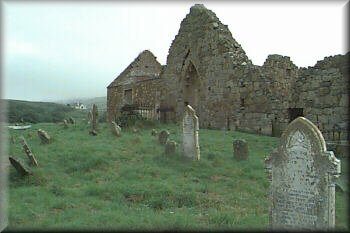
Bonamargy — “foot of the Margy,” the river formed where the Carey and Shesk meet — is a Franciscan friary founded in 1485 by Rory MacQuillan, one of the last friaries built in Ireland before the Reformation. It stood in MacQuillan territory, and the land nearby is thought to have hosted the first battle in the long-running feud between the MacQuillans and the MacDonnells.
Approached originally through a small two-storey gatehouse, the friary church is long and rectangular, roofed with thatch in its working life, and still retains much of a fine east window. Against the south wall stands a MacNaghten tomb dated 1630, and a low, holed cross near the west end is traditionally said to mark the grave of Julia McQuillan — known locally as the “Black Nun of Bonamargy,” a recluse who lived here in the 17th century and was said, in local tradition, to have prophesied events that came to pass.
The friary was burned in 1584 during English military campaigns in Ulster, but the friars continued using the church for much of the century after, and the last monks didn’t leave until 1790. A sealed vault holds the remains of several MacDonnell chiefs, most notably Sorley Boy MacDonnell, along with the Earls of Antrim — see The MacDonnells for his story.
In 1822, an oak chest was found in the friary’s chimney containing illuminated Latin manuscripts — believed to be 12th-century theological work attributed to St. Thomas Aquinas.
A stairwell leads up to the roof, where there are good views over the golf course and the surrounding coast — local tradition warns against stepping on the thirteenth step on the way up.
Location
On the edge of Ballycastle Golf Course, on the east A2 coast road, within easy walking distance of the seafront.